Emergence-Based Organizations: A Vision of the Future

A hundred years ago the world of work was undergoing a disorienting revolution and it was obsessed with efficiency.
Sound familiar?
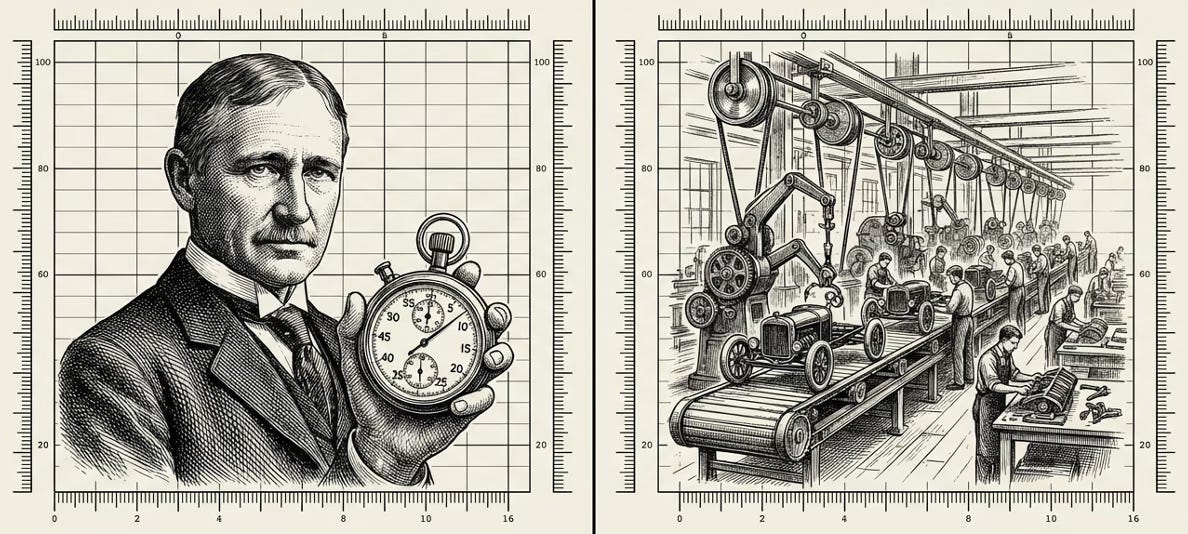
One prevailing school of thought, pioneered by Frederick Winslow Taylor, focused on the worker. He believed that if you broke a job down into its smallest constituent motions, and optimized each one, you could create a much more efficient worker. Taylor sought to atomize labor.
On the other hand, Henry Ford was focused on the work. Ford resented Taylor’s fixation on the workers; he didn’t want to manage workers, he wanted to manage the process. With the assembly line, he sought to atomize the process into tasks, bringing the work to the station so that the system dictated the pace.
Both approaches relied on the same underlying assumption: Aggregativity. Both believed that a company was the sum of its parts. If you optimized the parts, or the sequence, you optimized the system.
The approach worked remarkably well for highly repetitive work. It worked so well we called it the Second Industrial Revolution. We got orders of magnitude more efficient at making a lot of the same thing. As we navigate the latest industrial revolution it’s only natural that we’d turn to age-old recipes.
Fast forward to the 2010s and Taylor’s Scientific Management saw a major resurgence. The concept of the skills-based organization arrived on the scene and was generally received as a new idea.
Just as Taylor advocated, to become a skills-based organization the first step was to deconstruct work into its underlying tasks. At the same time each employee was to be viewed as a collection of skills that could be dynamically matched to those tasks. Work was simply another supply chain problem. The important assumption that underlies this approach is that tasks are the functional unit of work, the atoms that make up a molecule.
What Is the Functional Unit of Work?
Consider caffeine.
If I told you that caffeine is made of carbon, hydrogen, nitrogen, and oxygen atoms arranged in a specific pattern, could you predict its effects? Could you deduce from that atomic inventory that it crosses the blood-brain barrier and blocks adenosine receptors, producing alertness? No. What caffeine actually does to a person emerges at a level of organization that cannot be deduced from the atomic parts alone.
Furthermore, the strength of caffeine’s effects depends on the physiology of a specific human body. The same molecule can produce different effects depending on metabolism, tolerance, what else has been consumed, time of day, and stress level. The strength of the effect emerges from the interaction between molecule and system.
The same principle applies to organizations. Skills and tasks are like atoms: they are necessary, but not sufficient to explain how work gets done. A team’s capability emerges from how its members interact with each other and with the organizational system around them. You cannot predict what a team will accomplish from a skills inventory any more than you can predict caffeine’s effects from a periodic table.
As we seek to understand the physics of organizations, the question is: what is the smallest meaningful unit of work?
The skills-based movement makes the claim that we should be engineering organizations at the atomistic level of the skill, or perhaps the task. However, if skills are not the functional unit of work then our picture may be incomplete in a way that leads to unexpected outcomes when we start making large-scale design decisions based on it.
What Skills-Based Organizations Get Right
Before we go any further we must acknowledge the tremendous value skills-based thinking has delivered in recent years.
Hiring Equity: The Rework America Alliance found that skills-based practices helped workers from lower-wage roles move into positions offering higher wages and more economic mobility.
Internal Mobility: Talent marketplaces that match employees to projects have saved hundreds of thousands of work hours at companies like Rolls-Royce and MetLife.
Transparency: With the half-life of a skill now estimated at less than five years, skills-based organizations provide visibility into capability gaps that job titles obscure.
These are genuine achievements. They matter to the people whose careers benefit. But there is a conceptual leap from “skills are useful for the organization” to “skills are the organization.” There is evidence to suggest that it is a leap too far.
The Case for Emergence
The skills-based model assumes that capability is aggregative. Put simply, if skills are the building blocks of work then as long as you have enough Python skills and Strategic Planning skills, you can arrange them into a capable organization.
On the contrary, organizational behavior literature and complexity science suggest capability is emergent. It cannot be assembled purely from skills and tasks any more than your mind can be reconstructed from a bag of neurons.
First, a clarification: skills are necessary. No one is arguing that you can build a high-performing team without individuals who have demonstrated proficiency in their field of expertise. The question is whether skills alone are sufficient to explain how an organization produces value.
The question matters beyond academic interest. If productivity is in fact an emergent property of the organization, as defined by complexity science, then the aggregative approaches of the 20th century won’t work. To test this claim we can use William Wimsatt’s via negativa: emergence is a “failure of aggregativity.” This concise statement, along with the four tests he outlines, provides a powerful lens through which to scrutinize the limits of decomposing work into skills.
For a system property (e.g., a team’s ability to innovate) to be considered a sum of its parts, and thus manageable by a skills-based model, it must pass four restrictive conditions. If the property fails these tests, we can consider it emergent and we have to reject Taylor’s and Ford’s models.
Condition One: Invariance Under Rearrangement. In a pile of gold bars, the total value is the same whether you stack them in a pyramid or a line. Your wealth is invariant to the arrangement.
Skill Test: If you take a software team and rearrange their interactional structure, moving them from an agile squad to functional silos, their productivity changes drastically. The same ten engineers, with the same skills, produce measurably different output depending on whether they sit together, share daily standups, and can interrupt each other versus communicating through tickets across a departmental boundary. The skills didn’t change. The topology did.
Result: Fails Condition One.
Condition Two: Invariance Under Substitution. In a LEGO wall, replacing a red brick with an identical red brick doesn’t change the wall. The parts are fungible.
Skill Test: Boris Groysberg’s study of more than one thousand star security analysts found that when stars switched firms, their performance plunged for at least five years. Same people, same set of skills, different results. Their performance was dependent on their specific web of relationships and institutional knowledge.
Result: Fails Condition Two.
Condition Three: Invariance Under Decomposition. A bank account balance is the same whether you view it as one sum or ten smaller sums.
Skill Test: Stasser and Titus tasked a committee with choosing the best political candidate. Crucially, they decomposed the information: they gave each member different clues, which, if combined, clearly identified the winner. The result? The groups consistently failed. Instead of pooling their unique puzzle pieces to see the whole picture, members fixated only on the few facts they already shared (aka the Common Knowledge Effect). The sum of the information was present in the room, but the integration, the actual competence, was destroyed by the decomposition.
This is what a skills taxonomy does to organizational knowledge. It decomposes integrated, context-dependent expertise into discrete labels (e.g., strategic planning, stakeholder management, data analysis) and assumes the organization can be reconstructed from the inventory. But the competence was never in the labels. It was in the integration.
Result: Fails Condition Three.
Condition Four: Linearity. If one engine produces one hundred horsepower, two produce two hundred.
Skill Test: Human systems are non-linear. Two researchers with complementary knowledge can produce a discovery neither could make alone. One plus one is greater than two. Conversely, Brooks’ Law shows us that adding more people to a late project often makes it later due to communication overhead. Two people who trust each other can have a difficult conversation that leads to a breakthrough. Add a third person and the same conversation may never happen.
Result: Fails Condition Four.
Across all four conditions, organizational performance can be shown to be non-aggregative. It is not invariant to rearrangement, substitution, or decomposition, and it is not linear. By Wimsatt’s criteria, organizational productivity is emergent. This is not a metaphor. It is a formal classification with specific implications: you cannot reliably predict system-level performance from component-level specifications. A skills taxonomy, no matter how comprehensive, is the wrong level of analysis for understanding how to build highly productive teams.
If Not Skills, Then What?
If skills fail the test for aggregativity, the natural question is: what doesn’t fail? What actually drives performance?
The evidence points toward something that hasn’t yet entered the HR zeitgeist, though pieces of it appear across several research traditions.
Daniel Wegner called one piece of it transactive memory, the collective system of “who knows what” that develops when people work together over time. It’s not what any individual knows; it’s the group’s shared map of its own expertise. When you remove a team member, you don’t just lose their skills. You lose a node in the team’s knowledge network, and the remaining members lose the ability to coordinate around that knowledge. Wegner’s insight was that this system is a property of the group. It cannot be decomposed into individual knowledge inventories and reassembled elsewhere.
Anita Woolley found another piece. Her research on collective intelligence showed that a group’s cognitive performance is not predicted by the average or maximum IQ of its members. You can stock a team with every skill in your taxonomy and every genius on your payroll, and their collective intelligence may still be mediocre. What predicts group performance is the social sensitivity, equality of turn-taking, and the communication network itself. The capability is a property of the interaction pattern, not the roster.
Amy Edmondson found a third piece. When cardiac surgery teams adopted a new technology, success depended not on the skill of the individual surgeon but on whether members felt able to speak up, flag errors, and propose alternatives without fear. Teams with identical technical skill profiles had dramatically different outcomes based on this single emergent property that no individual possesses alone.
Consider a thought experiment: you’ve hired the smartest person who has ever lived. They know everything. They can do everything. Are you guaranteed to have the most productive team? Of course not. If they sowed doubt and alienated the team members from each other, they might have the opposite effect.
What Wegner, Woolley, and Edmondson are each describing is the same underlying phenomenon viewed from different angles. The functional unit of productivity is emergent capabilities. Emergent capabilities are an integrated configuration of people, trust, shared knowledge, and communication patterns that produces performance no individual member carries alone.
If that is true, it changes what an organization should look like.
The Emergence-Based Organization
If emergent capabilities are the functional unit of productivity, then every major people-process in an organization needs to be extended to account for what skills alone cannot explain.
A skills-based organization asks: do we have the right skills in the right roles? An emergence-based organization asks a harder question: are our people configured in ways that produce emergent capabilities, and can we see when those capabilities form, degrade, or fail to develop?
This is not a rejection of skills-based thinking. It is the next layer. You cannot build emergent capability from unskilled people. But an emergence-based organization recognizes that assembling skilled individuals is where the work begins, not where it ends.
What would such an organization look like in practice?
Hiring. A skills-based organization treats hiring as a one-directional evaluation: does this candidate have the skills we need? An emergence-based organization recognizes that hiring is work for both sides. The team must adapt to the new member just as the new member adapts to the team. Emergent capabilities are properties of the configuration, not the individual. Groysberg’s research illustrates this clearly: star analysts who moved with their teams showed no performance decline, while those who moved solo suffered for years. The difference wasn’t skill. It was whether the receiving system was prepared to integrate them. Screening for individual proficiency remains necessary, but an emergence-based organization would also assess the team’s capacity to absorb a new member and actively prepare the configuration for the transition before the new hire walks in the door.
Onboarding. If hiring prepares the configuration, onboarding is where integration actually happens. The standard model optimizes for individual time-to-productivity: how quickly can the new hire complete tasks independently? An emergence-based organization would optimize for team recovery: how quickly does the team return to its previous level of coordination, knowledge sharing, and collective problem-solving? This reframes onboarding as a group activity. The entire team must be re-onboarded and is collectively accountable for the outcome. Success is measured at the team level, not the individual level.
Team Design. Most organizations design teams around reporting structures and skill coverage. An emergence-based organization would design around emergent capability. Which combinations of people produce the highest collective intelligence? Which configurations develop transactive memory fastest? When a team is working well, the emergence-based organization recognizes that the configuration itself has value and protects it from unnecessary disruption. When a team is underperforming despite having adequate skills on paper, the diagnosis shifts from “who is underperforming?” to “what is preventing emergence?”
Performance Management. We currently evaluate individuals and aggregate those evaluations upward. An emergence-based organization might consider a more objective measure of individual performance that is derived from the impact of that person on a team’s productivity. Imagine this as similar to plus/minus statistics from sports. An individual might be unremarkable when measured in isolation but have a disproportionately positive effect on every team they support. Conversely, a high-performing individual may be depressing the team’s emergent capability by dominating communication channels or undermining psychological safety. Neither of these situations is visible to a system that only measures individuals.
Workforce Planning. Traditional workforce planning models headcount against demand forecasts. An emergence-based organization would model the network impact of personnel moves before making them. When someone gives notice, the question is not just “what skills do we need to replace?” but “which emergent capabilities will degrade, and how do we minimize that degradation?” Internal mobility would be evaluated for its impact on the teams people are leaving, not just the teams they are joining.
Measurement. None of the above is possible without the ability to see emergent capabilities as they form, degrade, and recover. Until recently, measuring constructs like transactive memory, collective intelligence, and psychological safety required costly, point-in-time research interventions. These methods are far too slow for managing emergent capabilities.
Enterprise chats, emails, and tickets provide a continuous stream of interaction data: who communicates with whom, how frequently, on what topics, with what response patterns. This is the raw signal of emergent capability. This information has long been used for generating passive organizational network analyses, but privacy concerns have mostly limited these networks to volume of communications, not intent or context.
The enterprise LLM changes the equation. Viewed as a measurement device, it can make sense of communication exhaust to understand work while protecting the privacy and trust of employees. Any company could run a straightforward first experiment today: issue surveys in the form of a prompt that respondents execute in the LLM. The prompt surfaces a work summary that includes information necessary for organizational network analysis, skills mapping, and evidence of transactive memory, collective intelligence, and psychological safety. The employee sees exactly what information is being requested and can edit the results as desired. If initial experiments are successful, an automated employee-in-the-loop report could be generated at regular intervals that provides the information necessary to study and promote emergent capabilities while maintaining trust through transparency.
Two foundational measurement problems would need to be solved.
First: The Ephemeral Team. The map of who works with whom is not stored in a static org chart or a project management tool. The output of your company is highly dependent on teams that form and dissolve organically, that include members from multiple disciplines, and often span multiple projects. An always-on organizational network analysis with a refresh rate that matches the pace of business decisions would be a prerequisite to understanding those teams. Without the ability to see when and how teams form, we cannot understand how they operate. When someone gives notice, we should be able to see not just their job title and skills, but the network of teams and knowledge flows that will be disrupted.
Second: Emergent Health Monitoring. As teams form and disband in the natural flow of work, we need non-invasive ways to monitor the health of their coordination. This is not a sentiment analysis. A team with a high degree of psychological safety may experience spikes in conflict precisely because people feel safe communicating directly. What matters is the decay curve: conflict happens, but how quickly does the team recover? How quickly do they share expertise after a disruption? How rapidly does a new member become integrated into the team’s knowledge network? We would expect highly productive teams to be highly resilient.
Network topology, knowledge flow patterns, coordination speed, integration rates, and recovery curves are proxies for the emergent capabilities that Wegner, Woolley, and Edmondson identified. They are measurable. And they give us something we’ve never had before: a way to design every people-process around the actual emergent structure of the organization rather than a generic skills checklist or a static org chart.
Adaptive Staffing
Skills-based talent marketplaces promised a fluid organization where people could be dynamically matched to work. That promise has gone largely unfulfilled because the model was incomplete. Matching skills to tasks doesn’t account for the emergent capabilities that are disrupted when someone leaves or joins a team.
Realizing that vision will require achievement of lossless turnover. Lossless turnover is the ability to move people in and out of teams with minimal degradation of emergent capabilities. It requires everything described above: seeing the ephemeral team, monitoring emergent health, and measuring integration rather than just individual task completion. When the new hire arrives, success is not whether they can do their job. It is whether the team recovers its previous level of coordination, knowledge sharing, and collective problem-solving.
Achieving lossless turnover would enable the truly adaptive organization capable of deploying effective teams rapidly, not because it has a marketplace of interchangeable skills, but because it understands and can actively manage the emergent capabilities that actually produce value.
The Next Industrial Revolution
Skills-based thinking gave us a vocabulary for matching people to work. Emergence-based thinking gives us a vocabulary for understanding why some configurations of people produce extraordinary results and others don’t.
The practical question is not whether emergent capabilities matter. The question is whether we can build the measurement and management infrastructure to act on that knowledge. The pieces are available: organizational network analysis provides the topology, LLMs provide the semantic layer, and decades of research on transactive memory, collective intelligence, and psychological safety provide the constructs worth measuring.
What we lack is robust validated LLM-based measurement and integration. No existing HR technology platform was designed to manage emergent capabilities. Headcount management systems track individuals in roles. Skills platforms track attributes of individuals. Neither tracks the configurations of people that produce value. The emergence-based organization requires a new category that captures ephemeral teams and their emergent capabilities.
The hallmark of our success in this new Industrial Revolution will be a whole generation of technology for the organization fueled by a prolific era of organizational measurement and research.
Great post. If I had to summarize it in one sentence it might be, "Assuming an organization's workforce has at least the minimum level of skills needed to execute its strategy, its performance is likely to be influenced as much or more by internal team dynamics than it is by skill proficiency levels."
A larger cultural issue affecting this is the decreased value placed on employee loyalty and team stability. Teams need time to coalesce and strong relationships are built over years not quarters. Companies say they value retention yet few companies reward employees for being loyal and sticking around. Having long tenure can even be seen as a weakness due to implicit ageism and misguided beliefs about the value of job hopping (e.g., assuming that high performing people don't stay in one company). In addition, some companies restructure so often that groups are never able to coalesce into high performing teams. Part of this may be a result of the shortening tenure of CEOs. The median tenure of a Fortune 1000 CEO is now less than 5 years. Knowing their time is likely to be limited may pressure CEOs to take overly drastic action restructure companies even if it isn't warranted given the disruption it will cause to team dynamics.
This post is fantastic. I need to think about how to introduce these concepts to my greater team.