
Omniscience and Prosperity
What a crowbar to the face taught me about purpose in the age of all-knowing machines

I’m a terrible guitar player. I really am. Every so often I’ll hear a riff that makes me want to tune up my guitar and give it a try. It’s kind of weird that I do that if you think about it. I mean, what’s the point? Jimmy Page played it perfectly, it was recorded and mixed in a studio, and is available digitally for me to listen to as much as I want. If I want to hear Over The Hills and Far Away, playing it myself is probably the least efficient way to do it.
Lately I’ve been wondering about why hearing a song makes me want to play it. In general there seems to be a connection between learning something new and doing something new.
When I examine the things I know and the things I’ve experienced they seem to form a sort of coordinate system that overlays my personal mental map. Familiar bits of trivia and repeat experiences feel like familiar territory. New experiences or new facts push me into less explored corners, and occasionally, add whole new undiscovered domains.
There is established psychology behind this. Cognitive scientists refer to this map-building process as creating schemas, and attribute the urge to explore undiscovered corners to something called the information gap. We get a psychological itch when we realize there’s something we don’t know, and many of us are intrinsically motivated to scratch it.
Of course an information gap isn’t always motivating. Our curiosity peaks when the gap seems just out of reach and shrivels up as the gap becomes insurmountable. The important thing is that knowing that we don’t know something does something important to us.
The Power of a Map
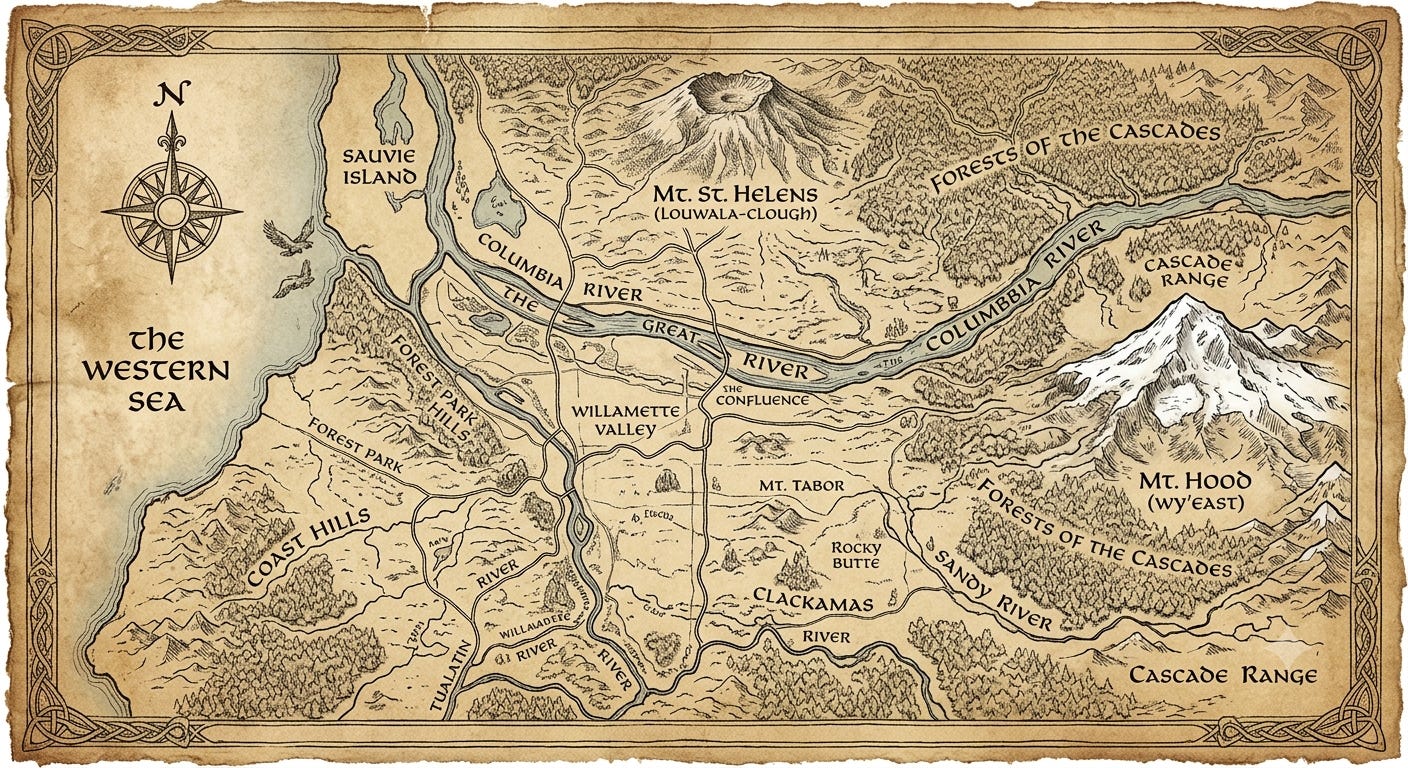
Think about how actual maps have influenced the course of human history. The speculative wild edges of early maps with their dragons and sea monsters drew the attention and inspired the imaginations of explorers but most people stayed away for fear of the unknown. As more and more detailed documentation of our planet became available it inspired more exploration, not less. Today the proliferation of high resolution satellite images, GPS, and stunning photography has drawn record numbers of people across the globe to experience more places for themselves. Why go to a place that has been exquisitely documented in 4K video? Because knowing about a place is not the same thing as experiencing that place. We are not just information processors, we are experience processors.
The big difference between facts and experiences is that facts transfer. I can share a fact with you and it is yours. Here’s an example. Fact: I accidentally stabbed myself in the face with a crowbar a few weeks ago. You’re welcome, I have given you the gift of a new fact. Unfortunately, what I cannot give you is just how stupid and worried I felt as I rushed to urgent care. You may tap into your own experiences to conjure some empathy but you still won’t have stabbed yourself in the face with a crowbar. Philosophers have long debated the relationship between types of information. We can avoid stepping into that debate by simply recognizing that, whatever you may prefer to call them, there are actually two kinds of information gaps: knowledge gaps and experience gaps.
To illustrate why this matters let’s run a little thought experiment. Imagine we wake up tomorrow and learn there is a new app that knows everything. Wild idea, I know. Its reasoning is flawless and instantaneous. It has the solution to every open math problem, understands every law of the physical universe, and has validated every fact ever digitized. It knows everything, how to solve everything and, lucky for us, it’s basically free to use.
This app’s only quirk is that it prefers you call it Dr. Jones when you ask questions. It’s a little weird, but a small price to pay for such a miraculous answer machine.
Does the fact that Dr. Jones is basically omniscient mean that you know everything? No, of course not, for the exact same reason libraries didn’t make us all geniuses. Like a great map, or a library, Dr. Jones does its best work when it shows you things you don’t already know. For example, you tell it how much you love coffee and it gives you every detail you would need to produce the perfect shot of espresso. As you ask more and more questions you begin to feel an urge to try producing the perfect shot. Dr. Jones has given you everything you need to know but it can’t give you the satisfaction of success. Only you can produce that satisfaction.
Dr. Jones’s limitations, despite its omniscience, are important. We derive our purpose from things we accomplish, large and small, on a day to day basis. When we aren’t overcoming a challenge, life starts to feel flat. So if our sense of purpose is the summation of the experience gaps we are perpetually about to close then no answer machine, however capable, can be a threat simply by knowing more than us. While the knowledge gap between you and everything Dr. Jones knows might be infinite, the gap between you and your first decent espresso shot is one afternoon. By presenting closeable gaps in our knowledge and experience it could inspire us to higher degrees of creativity and entrepreneurship than we ever thought possible.
An Engine of Prosperity
Someone else eating a meal has never once satisfied my hunger. That’s such an obvious fact that it’s easy to forget how important it is. Roughly 70% of the US economy is driven by things we need or want and nearly all of those things are only a benefit if they are directly consumed or experienced. Hundreds of millions of people attend concerts each year. Not one of their experiences satisfied my desire to go to a concert.
The demand side of every industry remains stubbornly, biologically ours.
But what about the supply side? If a machine can out-think us, out-play us, and out-produce us, don’t we eventually just quit? Weirdly, no. In 1997, Deep Blue beat Garry Kasparov, and chess engines have been unbeatable ever since. By the logic of pure efficiency, chess should have died that year. Instead, chess as an industry boomed in the wake of Deep Blue. Chess is more popular now than at any point in its history, and the machines that beat Garry have become the training partners of a generation of people looking to master the game. Why? Nobody plays chess solely to discover a smart move. They play for the experience of playing a smart move.
The same pattern shows up anywhere mastery is on display. YouTubers streaming flawless speed runs of popular video games drive sales up, not down. Players seeing the game beaten shows them what is possible and inspires them to try, not to declare QED and move on. Exposure to perfection opens an experience gap that gives many of us the itch to try.
If your plan was to monetize facts about espresso then Dr. Jones definitely represents a challenge to your business model but, have no fear, consumers in the US who have access to safe drinking water still spend over $50B a year on bottled water. Even information brokers can thrive in the presence of omniscience because facts are almost never the goal.
Clumsy guitar playing, amateur painting, and weekend gardening aren’t cute accessories to our lives. They are evidence of human curiosity and ingenuity. The messy, imperfect pursuit of personal experience drives entrepreneurship, creates industries, and, most importantly, gives people meaning. It turns out the urge to have things and do things, not just know things, has always been the engine of our prosperity.
Chasing the Rabbit
When dogs race, they aren’t spurred on by jockeys pushing them toward a finish line. They chase a mechanical rabbit sent along the track ahead of them. The rabbit is a moving goal that stays just out of reach without ever seeming unreachable.
The rabbit taps an instinct in the dogs because it is not so slow as to be catchably boring and not so fast as to be impossible.
Our apps are rabbits, whether we design them that way or not. Tuned to reflect only what we already know, an app can make us stagnate. Tuned to be inaccessibly brilliant, it can fail to grab our attention. Tuned well it can trigger our instinct to explore. Our apps can and should expose us to understanding far superior to our own, show us things we didn’t ask for or expect, present us with viewpoints we hadn’t considered. They should show us what is possible, maintaining a constant, motivating knowledge gap in any direction we look. A knowledge gap sized to be chaseable, opening onto an experience gap only we can close. Fostering the autonomous motivation that is so critical to our vitality and creativity should be the prime directive for the creators of apps like Dr. Jones.
I think engineering that gap is some of the best work in front of us. Most of today’s apps are engineered for engagement: they measure success by how long we stay. A well-designed rabbit would measure success by what we did while we weren’t looking at it. Getting the pace and direction just right is a design discipline we’ve barely begun to understand.
If we wake up tomorrow and Dr. Jones has miraculously solved the universe, it will have finished the map and we will still have experienced very little of it.
A perfect map shows you every place you haven’t been. It can never go there for you.
Now if you’ll excuse me, Over the Hills and Far Away is calling to me. Those chords aren’t going to play themselves.
