The Equation on the Gravestone
More About Scale and Prediction.

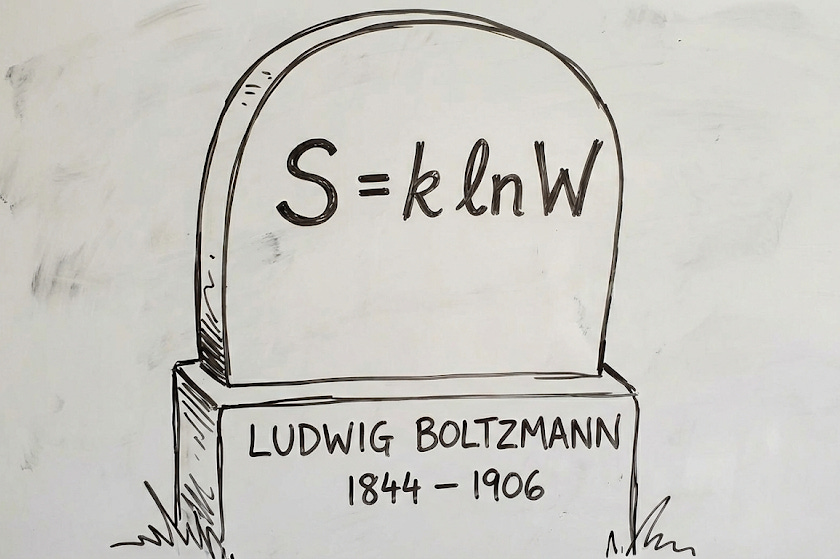
In the Central Cemetery of Vienna, among the monuments to Beethoven and Brahms, stands the headstone of Ludwig Boltzmann.
In an era when scientists were arguing about whether atoms even existed, Boltzmann was busy proving how their invisible, chaotic movements created the physical world we touch and feel.
Carved into the stone above his name is a deceptively simple formula:
S = k ln(W)
People Analytics leaders should spend more time understanding this formula, it is the secret to why you can predict and direct the behavior of a 100,000-person organization but not your top engineer.
The “Big Picture” vs. “The Individual Story”
To understand Boltzmann’s insight, we have to look at the organization through two different lenses. In physics, these are called the Macrostate and the Microstate. For our purposes, let’s call them The Big Picture and The Individual Story.
1. The Big Picture (Macro-Conditions)
This is what we track in our dashboards. It’s the “temperature” of the company. It’s your global turnover rate, your average engagement score, or your quarterly productivity yield. These are stable, measurable, and often very hard to move.
2. The Individual Story (Micro-Details)
This is the reality on the ground. It is the exact, messy, fluctuating state of every single employee at 10:00 AM on a Tuesday. It’s who had a bad night’s sleep, who just got a headhunter’s call, and who is feeling energized by a new project.
What is “W”?
The magic of Boltzmann’s equation is the variable W.
In physics, W is “multiplicity.” In business terms, W is simply the number of different individual stories that can result in the same Big Picture.
Imagine you have an organization with a 10% annual turnover rate.
The Individual Story: Why did “Sarah” leave? Maybe her significant-other took a new job. Why did “John” leave? He wanted a higher salary. Each story is unique, unpredictable, and seemingly random.
The Big Picture: There are a staggering number of ways (W) to combine these individual exits to reach that 10% mark. You could have 10,000 “Sarahs” or 10,000 “Johns,” or any combination in between.
Because there are trillions of ways for an organization to behave “normally” (high W), the organization almost always behaves normally. The sheer volume of individual chaos creates the stability of the aggregate.
The “Noise” Makes it Work
In People Analytics, we often treat individual variation as something to be eliminated. Boltzmann teaches us that this noise, W, is why we can reliably measure the big picture.
Imagine a company with precisely 1 person. You could attempt to measure engagement, attrition, or any other organizational measure, but it would be meaningless. Engagement, for example, would fluctuate wildly within the same day. You would find that the moods of that one person were more closely related to their sleep patterns than anything happening at work.
The reason your 100,000-person organization is predictable isn’t that everyone is following the same script. It’s because they are all following different scripts. Their individual idiosyncrasies, personal crises, and sudden bursts of motivation cancel each other out at scale.
The larger the organization, the higher the W, and the more “statistically locked” the Big Picture becomes.
Stop Managing Atoms
As you come to appreciate the brilliance of S = k ln(W), it will change your strategy as a leader:
Don’t Manage the Micro-Details: Trying to predict exactly which high-performer will quit is like trying to manage a single oxygen molecule in a room. It is an expensive, high-error exercise in futility.
Adjust the "Container": If you want to change the "Big Picture" (e.g., lower your turnover), you don't do it by micromanaging individual stories; you change the boundary conditions of the system. You get your best results by changing the characteristics of the company rather than by attempting to change the characteristics of each employee. This is why economists focus so heavily on incentive structures when predicting the behavior of the masses.
When you change the compensation structure, the culture, or the technology stack, you are changing the characteristics of the company, the boundary conditions. You are shifting the entire statistical distribution.
We don’t need to control the individual to lead the compay. We need to understand the math of the crowd.