
Unusual Stuff Plays
How competitive variety is the key to modern talent strategy.


This article was co-published on Variance, Explained.
What the Tampa Bay Rays are doing shouldn’t be possible.
In the last decade, they’ve had six consecutive seasons with a winning record and five playoff appearances. That’s more than the Boston Red Sox, tied with the New York Mets, and one shy of the Chicago Cubs and Toronto Blue Jays. But when you look at the Rays’ cumulative payroll for the last 10 years, they rank 30th. Out of 30.
In 2020, the Rays reached the World Series and faced the Los Angeles Dodgers, a team that outspent them threefold. In 2023, the Rays won 99 games, and their payroll cost per win was $752K. Meanwhile, the Dodgers paid $2.2M per win. The New York Yankees, $3.4M. The Mets? $4.7M. And the Rays have done it year after year, on roughly the same payroll, from the same concrete bunker of a stadium in the same tough market.
You could say the Rays have a killer workforce strategy.
The standard explanation for the Rays’ sustained success is that they simply “Moneyball” their way to wins by exploiting market inefficiencies. They certainly find value where others see a lost cause, but they aren’t playing Billy Beane’s game. There’s a more profound organizational mechanism at work here, one that offers a blueprint for the modern enterprise.
The reason Moneyball remains a corporate fantasy is a matter of measurement quality. Baseball isolates individual performance in a clean, high-frequency data environment; corporate environments do not. When companies try to replicate this by doubling down on standardized pre-hire assessments, they often forget that these assessments typically explain a meager 4% to 9% of the variance in actual job performance. To put it bluntly, traditional talent screening tools fail to explain more than 90% of the variance in how an employee actually performs. Seeking the perfect predictive hiring algorithm is about as promising as waiting for a Back to the Future hoverboard.
The Rays take a different approach: instead of trying to predict performance by minimizing human variance, they have figured out how to turn that variance into an asymmetric advantage. The deliberate heterogeneity of their roster allows them to constantly reconfigure, outmaneuvering more rigid opponents. To understand how this works, we’ll look to an unexpected source: the laws governing astrobiology and mineralogy.
A Law for Evolving Systems
In 2023, Michael Wong and his eclectic group of colleagues published a paper proposing a “missing law of nature.” They called it the Law of Increasing Functional Information, and it claims that any system that continuously generates new configurations, and retains the ones that work, will grow more capable and more complex over time. The research showed that this process explains the biological variety we see around us, the variety of minerals found naturally on earth, and the variety of atoms produced in stars. Everywhere you find natural, functional variety, you find three conditions have been met:
The system has many components that can combine into a vast number of possible configurations. Imagine a bucket of Legos. The more variety of pieces in the bucket, the more optionality we have for things we can build.
Processes exist that actually generate many different configurations. The more we play, build, and experiment, the more Lego creations we will produce.
Configurations are selected based on function. The more sturdy or useful the creation, the more likely we are to keep it. If a creation doesn’t work, it just ends up back in the bucket.
Variety as a result of success can also be observed in organizations: If a company is successful for long enough it will become more complex over time. This complexity can be seen as a byproduct of success, not a failure of bureaucracy. What’s interesting about the Rays is that they win by using the Law of Increasing Functional Information to their advantage.
How The Rays Do It
1. Hire for variety
There’s a phrase that circulates among baseball analysts to describe the Rays’ pitching philosophy: “Unusual stuff plays.” It’s a deceptively simple idea, and it echoes the first condition described by Wong and colleagues. While almost every team in the sport competes for the same top prospects and free agents, the Rays have found a gold mine in players discarded by other teams. Misfits who have flamed out, been injured, or been cut tend to be very different from your typical high-performing pitcher. Being different is precisely the point.
Look at the pitching roster that brought them to the World Series in 2020: Aaron Loup’s horizontal release point was the second-most extreme of any lefty in baseball; Ryan Thompson was a submariner from the right side; Pete Fairbanks had the third-highest vertical release in the league. That variety created sensory overload for hitters, and it wasn’t an accident. The Rays curated a range of arm angles and pitch shapes designed to disorient their opponents.
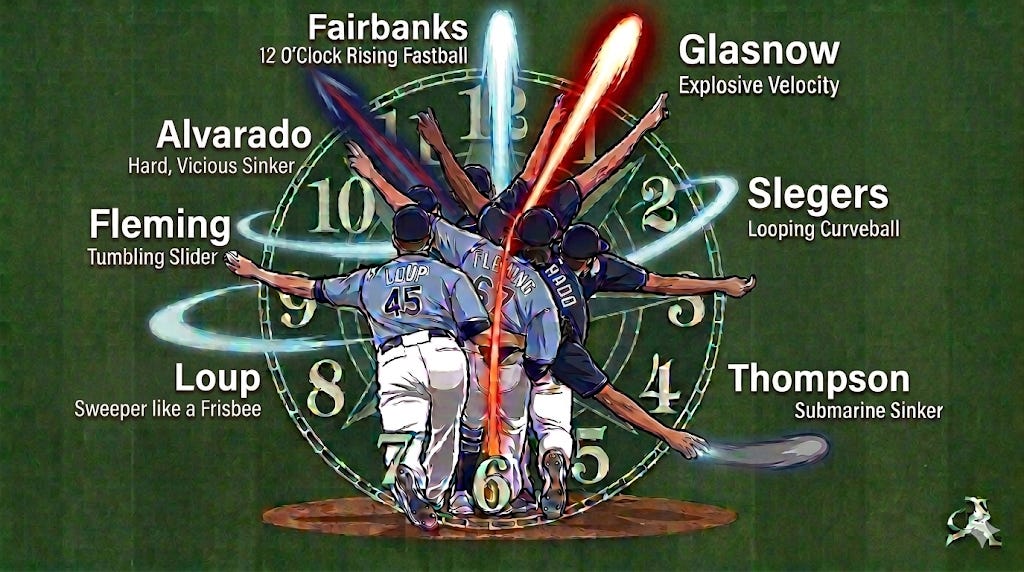
Caption: “Image concept: Lance Brozdowski”
Most hiring systems work in precisely the opposite direction. When organizations seek to identify the “ideal candidate” or develop employees into the profile of the “high performer,” they expressly reduce variation. Hiring this way will give you a bucket full of similar Lego pieces: the same employees everyone else is also trying to hire, doing the work in the same way. This kind of roster is easy to build and manage because it is predictable … for both you and your competitors.
2. Treat configuration as a verb
A bucket full of unusual pieces is only useful if someone is actually playing with them. This is the second condition of the law: Configurations have to be tried, abandoned, and tried again in a new way.
In 2018, the Rays were off to a poor start to the season and looking for an edge. One afternoon in May, they deployed Sergio Romo, a relief pitcher, to start the game before handing it off to a traditional starter. This was basically unheard of. Relief pitchers typically enter later in the game to take over for the starter, but this new configuration allowed the opening pitcher to handle the best hitters the first time through the order, letting the primary pitcher go deeper into the game. Thus, the “opener” was born.
They did so much wacky stuff a 2019 New York Times article called them a “surrealist’s delight.” They’d put four men in the outfield. They’d stack three infielders on the same side. They’d move a player between three fielding positions on the same night. In 2021, the Rays deployed 102 different players, almost 30% higher than the league average. Every transaction, every role change, is a new combination being tested.
The Rays routinely trade away good players, and not just for cost efficiency. Letting go of fully developed, expensive players also creates space for roster configurations that couldn’t have existed otherwise. Instead of a liability, turnover is an opportunity. It might not be known which team got the better end of a deal for months or years after a trade happens, but the Rays have made so many savvy transactions over the years there’s a joke among baseball analysts that the Rays have “won” the trade before the terms of the deal are even known.
Interestingly, the Rays also create new configurations by molding their players into new shapes. Take Tyler Glasnow. He arrived in Pittsburgh as a rookie looking like a video-game pitcher: a 6’8” frame, a fastball that flirted with 100 mph, and a curveball that buckled knees. And he completely flamed out. His velocity waned, his command withered, and his confidence plummeted as fast as his strikeout rate. The Pirates treated Glasnow like a lost cause, relegating him to mop-up duty in the least important role on the pitching staff.
The Rays acquired Glasnow when his stock was in the basement and overhauled his mechanics and his mentality. They added a vicious slider to his mix. They told him to stop stressing about command and just throw gas over the plate. He blossomed into their ace and one of the best pitchers in the game for several seasons, striking out a third of the batters he faced and holding hitters to under .200. In an interview about Glasnow’s transformation, Rays GM Erik Neander said “In many ways, disruption can help a young player find success,” and that was equally true about the Rays’ philosophy as a whole.
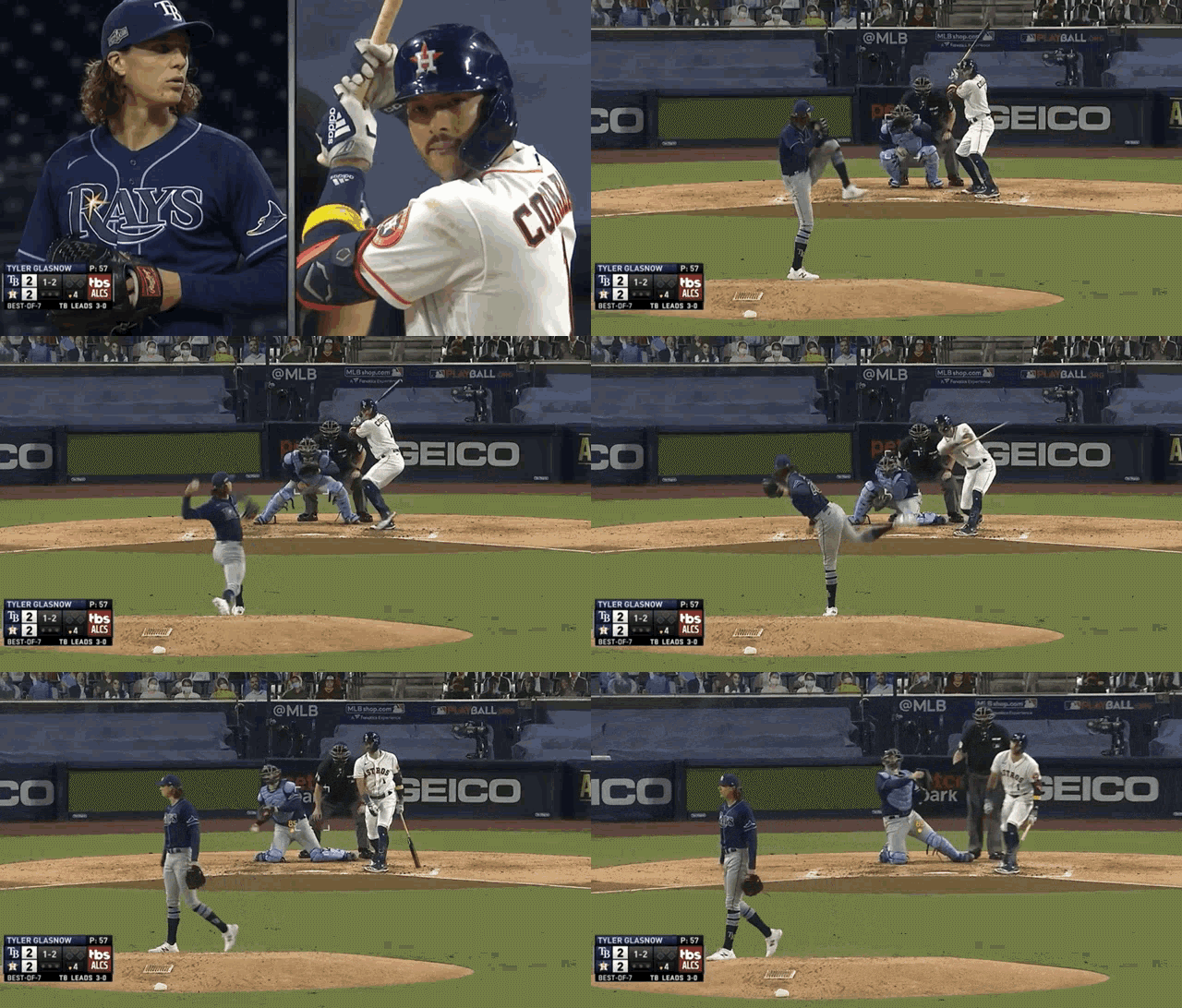
Caption: Here’s Glasnow’s curveball making a fool of one of the most disciplined hitters in the league. https://tenor.com/view/tyler-glasnow-gif-19275013
Many organizations continue to chase static job architectures and strategic workforce plans as if they are durable infrastructure. They treat disruption as a threat to be mitigated, while the Rays use it as a catalyst for evolution. A great job architecture won’t set you up for success 10 years from now, and maybe not even 18 months. A rigid company is a fragile company. We end up hostage to high performer retention because we’ve made our bet on a single configuration. All of this tilts the org away from the very flexibility that makes strategic variety possible and limits exploration.
3. Select for function
Variety and configuration produce a flood of possible configurations. The third and final condition is selection: The system has to keep what works and discard what doesn’t.
Jonathan Erlichman became baseball’s first Process & Analytics Coach in 2018, originally hired as a 22-year-old intern with a Princeton math degree and a competitive sports background that started and ended with kindergarten T-ball. They call what he does “outsiderball.” His job, essentially, is to make sure all the experimentation the Rays run actually generates useful knowledge. He seeks to answer the question, does this configuration work, and at what cost? That work cuts across scouting, analytics, coaching, and front-office operations because it can’t be answered from any one of those vantage points alone.
The Rays’ analytical sophistication doesn’t come from tracking or predicting distal, retrospective outcomes like wins, strikeouts, and ERA. Every pitcher is evaluated not just on current performance but on the configurations he might enable. The focus is the whole roster, not the player in isolation. They look at what an extra pitch might make possible in the bullpen they’re assembling. The feedback is fast, granular, and narrowly focused on the next opponent. They don’t ask: Who is the best pitcher? They ask: Who is the right pitcher against Anthony Rizzo and two other lethal lefties in the seventh inning at Yankee Stadium with the short porch in right?
There’s an app called Rebrickable that Lego enthusiasts use to inventory their pieces and discover what they can build. The Rays have built the organizational equivalent. The 102-player season isn’t just about generating unique configurations; it’s also about rapid culling. They maximize flexibility and specificity, and keep a running record of what their pieces can become and they use it to decide what to keep on the table and what to put back in the bin.
Most organizations have no Rebrickable equivalent. They (sometimes) know what people are doing. They (might) know what they want people doing. They have no systematic knowledge of which unique groupings of people were particularly effective for which situations. That kind of latent knowledge won’t show up in retrospective performance reviews built on role-based outputs. Standard practice is to assess performance at the individual level, attributing the outcome of a complex, interdependent system to the most visible person. The configuration of the team goes unremembered and unevaluated. Feedback is too slow, too broad, too abstract. Performance management is built to assess a person, not to surface the configuration that would make the person work.
How to start playing
The Rays philosophy emerged out of necessity. An ex-Goldman Sachs exec bought a dismal baseball team and applied the same logic he’d used on Wall Street: find undervalued assets, use data to develop and deploy them, and move them on when they get too expensive or when the portfolio needs to be rebalanced. Through trial and error he learned that the way to do that was not to find better players to construct teams through variety, configuration, and experimentation. Here’s how organizations can do it too.
Vary the bucket. If your hiring and development systems reliably produce people who look like your current high performers, you’re not building a varied bucket. This strategy works pretty well, as long as nothing in your organization or market ever changes. Instead, deliberately selecting for people whose capability profiles don’t match your current set creates competitive variety. It’s a way to hedge against a future none of us can predict.
Play with the pieces. Internal mobility in most organizations is either very slow or totally haphazard, and team composition tends to be rigid. Consider what it might look like to have working groups that are less like rigid org charts and more like tiger teams that convene and disband episodically and organically. What if attrition of high value, highly paid high performers were treated less like failure and more like an opportunity? What if we flipped things around and genuinely considered whether underperformers might also have high potential? How many 2017 Tyler Glasnows have walked out the door of a company because their talent programs didn’t leave room for the imagination to experiment? The winners of the next decade may just be the companies that excel at rapid testing of new combinations of people and processes. Career development may look less like a linear series of roles and more like a portfolio of responsibilities and projects.
Create a system that learns. This is the hardest one and probably the prerequisite for everything else. Most organizational measurement is pointed at the individual. The thing we need to spend more effort to understand is the configuration, or team, that could benefit the most from this person. That is a very different question and it requires constant experimentation.
To make it real, imagine we adopt the same approach to leadership as the Rays do when selecting pitchers. Instead of chasing the elusive concept of “leadership potential,” we might instead focus on identifying the type of leadership situation a person might excel in. Could this individual lead a team that undergoes significant change? Can they rehabilitate a dysfunctional team? Can they build something from scratch? Can they optimize an existing system to the fullest extent? Achieving this requires HR to play “outsiderball.” They need to comprehend what teams actually produce, collaborate with Finance to track which systems generate financial returns, and work with IT to obtain real-time data that facilitates learning. While most organizations possess this data, few utilize it comprehensively to assess the effectiveness of leaders in specific situations.
The Rays are proof this is possible without infinite resources. The Dodgers are proof that it scales. Following the Rays success, Los Angeles basically copy-pasted the Rays’ philosophy (not to mention their front office) and have shown that it’s repeatable. A larger budget only enables more configurations in an unusual-stuff-plays strategy and becomes almost unstoppable. The Dodgers have been to five of the last nine World Series and won three of them. If that’s not a dynasty, I don’t know what is. The budget helps but it isn’t the core of the strategy; it’s the belief that this system matters more than any single star player within it. That belief, as it turns out, is backed up by the mechanics of our universe.
As far as we know, the Rays didn’t build their talent philosophy based on astrobiology theory. They had constraints and the nerve to innovate. Most organizations already have the variety, the configuration potential, and the data they need to start playing. The boldness to experiment, though … that’s what makes unusual stuff play.
————
Tyler Weeks, PhD, writes about organizational physics, people analytics, and workforce strategy at First Principles.
Colby Kennedy Nesbitt, PhD, is an organizational psychologist, inveterate sports fan, and talent strategy leader. She writes about those topics at Variance, Explained.
 | A guest post by
|
Classic market inefficiency. All of MLB copies - go for home runs; who cares about Ks? Rays come in and say what about just filling the bases with really fast guys? All these guys who are high-on-base percentage guys and really good at defense that no one values. Classic Moneyball that everyone fell out of favor with, but there's more than one way to win games.